Privacy filters: what they do and what they do not

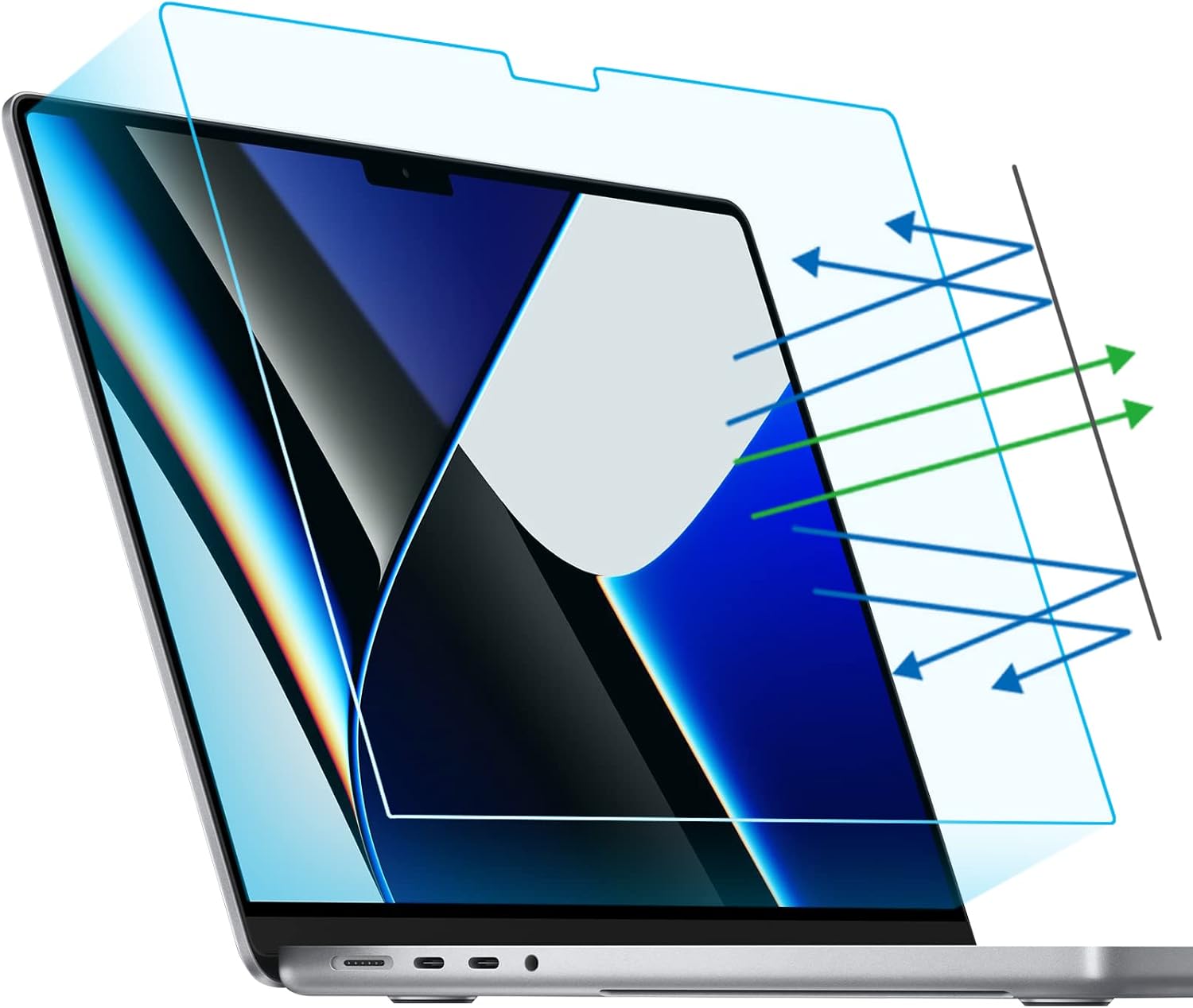
A privacy filter is a sheet of micro-louvred plastic that sits over the screen. The louvres are angled vertical strips, in effect thousands of tiny venetian blinds, and they let light through straight ahead while blocking it at an angle. From directly in front the display looks normal; from about thirty degrees to either side it goes black.
That is the whole mechanism, and understanding it tells you exactly what a filter is and is not good for.
What it actually protects against
Shoulder surfing from the side. Somebody in the next seat on a train, the person at the adjacent desk, anyone walking past behind and to one side. That covers the overwhelming majority of casual screen-reading in public and it works well.
It is genuinely effective for this. In an open-plan office or a commuter carriage, a filter turns a readable screen into a dark rectangle for everyone except the person in front of it.
What it does not protect against
Anyone standing directly behind you sees everything. The filter restricts the horizontal cone and does nothing vertically on most designs, so somebody looking over your shoulder from above has an unobstructed view.
It is also not a security control in any meaningful sense. It does not encrypt anything, it does not stop a photograph taken from in front, and it is no substitute for locking the screen when you walk away. Treating it as privacy hygiene rather than as security is the right framing.
The brightness cost
Louvres block light, including the light going towards you. Expect to lose somewhere between a quarter and a third of perceived brightness, which means turning the display up and using more battery.
On a bright screen indoors this is barely noticeable. Outdoors, or on a dim panel, it can be the difference between usable and not. If you work outside often, test before committing.
Matte, glossy and the anti-glare question
Privacy filters come in both matte and glossy finishes and the choice is separate from the privacy function. Matte scatters reflections, which is what you want under overhead office lighting or near a window. Glossy preserves contrast and colour better.
If your main complaint is reflections rather than onlookers, a plain anti-glare film is cheaper, loses no brightness to speak of, and solves the actual problem. Do not buy a privacy filter to fix glare.
Anti-blue-light film is a different product again
Blue-light filtering film has a slight amber cast and reduces the short-wavelength output of the panel. Whether that matters for eye strain is genuinely contested; the evidence for sleep effects late at night is stronger than the evidence for daytime comfort.
What is not contested is that it shifts colour. If you do any work where colour accuracy matters, this film is the wrong choice, and the software night-shift setting built into every operating system does the same job reversibly and for free.
Fit is not negotiable
Filters are cut to a specific panel size and aspect ratio, and a fifteen-point-six-inch sheet will not fit a sixteen-inch display even though the numbers look close. Screen size is measured diagonally, so a small difference in the diagonal is a larger difference in width.
Measure the visible panel, not the lid, and match the aspect ratio as well as the diagonal. Every listing here states the machine or the panel size it is cut for, and if you are unsure, the model number on the underside of the laptop is enough for us to check.
From our shelves
Filters, matte film and camera covers, listed by the screen size each one fits. Everything below is in stock as this piece is published, and the prices shown are read live from the catalogue rather than typed into the article, so they cannot drift out of date. Across the whole group prices currently run from $5.99 to $17.99, and the listing pages carry the full specification for each one.
- F FORITO 2-Pack Anti Blue Light Matte Screen Protector for MacBook Pro 14-inch (2021-2026 M1-M5 Chip) — $17.99
Protect your eyes and MacBook Pro 14-inch with the F FORITO 2-Pack Anti Blue Light Matte Screen Protector. This essential accessory reduces glare, blocks harmful blue light, and resists scratches for a superior viewing experience. - KEANBOLL 3-Pack Anti-Glare Matte 15.6" Laptop Screen Protectors — $9.98
Protect your eyes and your laptop screen with this 3-pack of KEANBOLL anti-glare screen protectors. Designed for various 15.6-inch models, they reduce reflections, minimize fingerprints, and guard against scratches for a clearer, more comfortable viewing experience. - MUBUY-GOL 15.6" Laptop Screen Protector, Anti-Blue Light & Glare Filter, 16:9 Aspect — $8.98
Protect your eyes and improve sleep with the MUBUY-GOL 15.6" Laptop Screen Protector. This matte finish filter reduces harmful blue light and glare, making your screen more comfortable to view for extended periods. - Toojcc 6-Pack Ultra-Thin 0.022in Laptop Camera Cover Slide for Privacy — $5.99
Enhance your digital privacy with the Toojcc 6-pack of ultra-thin webcam covers. These minimalist slides easily block your laptop, tablet, and smartphone cameras, preventing unwanted intrusion without affecting device closure.
These are 4 of the items in Screen Protection and Privacy; the category page lists the rest with current stock and pricing.
Ordering, delivery and returns
We charge $5.99 for delivery, waived entirely on orders of $49 or more. Orders are packed in one to three business days and travel for five to ten, so plan on six to thirteen business days between placing an order and opening the box. Everything ships from Brooklyn, NY, to United States addresses.
If something is not right, the return window is 30 days from delivery for unused goods in their original packaging. The Shipping Policy and the Refund and Returns Policy carry the detail, and the FAQ answers the questions that come up most often.
Read next
- Screen height is why your neck hurts by four o’clock
- Choosing a laptop sleeve that actually fits
- Laptop cooling: what actually helps
Browse everything in stock or ask us a question — we answer written enquiries within one business day.